Showing posts with label Ventilation. Show all posts

Friday, July 1, 2016

What is Passive House Comfort?

Superior Comfort is achieved Passively

Passive House is just as much about comfort as it is about energy efficiency. But what is COMFORT?

Passive Houses are ultra comfortable because:
1) They are ALWAYS Draft Free!
2) They are ALWAYS Quiet!
3) They are ALWAYS Let in Lots of Sun Light!
4) They are ALWAYS Warm!
5) They ALWAYS have Fresh Filtered Air!
6) Oh - they are ALWAYS Low Energy!

So lets talk "Comfort" for a minute... While writing this post I did an internet search for images of "Comfort" and after seeing photo's of Mattresses, Bra's and Lasagna and having a good laugh and some internal comments about our society I decided I had to narrow down my search to "Home Comfort".

There were 2 common themes:
Fireplaces, coffee, blankets and snow out the windows
Fireplaces are not exactly Passive House Comfort

So this is a little closer
White, bright, couches and smiles
Now - guess the season... You never know in a Passive House!


So, there is more to comfort than temperature

As mentioned above, the things that effect your comfort include:

  • Drafts - either near a heating or cooling duct, or near a window. In the insulation industry, drafts are the most common comfort complaint.
    • When the furnace kicks on you get a blast of cold air before it becomes hot. If your furnace is not sized properly you get this event more often than you should.
    • You typically feel this if you have inefficient glass (single or double pane) and warm heated air. The warm air will cool off when it hits the window and drop (since cold air is heavier than warm air). The dropping of air is the draft you feel. 
    • There are the most obvious drafts you feel that are coming directly from the outside. Through electrical outlets, under the baseboard, under doors, around windows, into the basement, etc. 
    • Drafts near chimneys are very common as well. Neither the glass doors nor the flu create a perfect seal. Cold air will drop and be drawn into the house.  

Not in a Passive House. There are no air leaks, there is no furnace, the windows are super insulated and there is no chimney. Drafts are an aspect of comfort that often get overlooked.
  • Noise - Have you ever heard a train blow it's horn, or your neighbor's dog bark at dawn on a Saturday or an airplane fly over, or those construction vehicles work near your house? We have all experienced this in a house before. But since we have just learned to live with it we don't realize how annoying these things can be. 
Thanks Floris from 475 HP Building Supply

Outside sound is not a problem in a Passive House (as you can hear from the short video from above). There is also no problems with noise from inside either. All of the mechanical equipment in the house is tested to operate almost silently. There is no Jet Engine noise from the bath fans (there are no bath fans), there is no swoosh of water from an upstairs toilet flush in the downstairs walls (from insulated drain pipes), there is no rumble followed by a winding noise from the furnace kicking on (there is no furnace). We have lived in noisy houses all out life and have learned to live with it without knowing we could do something about it. Passive Houses are quiet!
  • Daylighting
Another important aspect of Passive House is proper orientation. There is typically a lot of south facing glass. However when you utilize the Passive House windows they can be arranged on any side of the house. While we do utilize some of the passive solar techniques, they are not vital to the success of a passive house. In the Rochester Passive House - EVERY room has a window in it. In fact the 2 long walls of the house face East / West. We did what we could to maximize the southern window exposure and were smart about window size everywhere else. We even added a transom window in the 2nd floor laundry room to give that room some natural light.  
  • Surface temperatures (Not just heated floors)
The number one comment we get from clients looking for a high performance house is..."We have to have radiant floor heating". So comfort is obviously important and our clients have done the research and found that radiant heating systems are more comfortable than forced air systems.

The radiant floor heating typically will over heat a passive house. 


Passive House Design utilizes some Passive Solar techniques to help heat the house in the winter - with proper shading to ensure cooling in the summer. 

What exactly is radiant heat transfer? Well, without getting into Planck's Law, Stefan-Boltzmann Law and blackbody emissive power... It is essentially any materials ability to give off or receive infrared energy to other objects within a line of site of each other.

Huh??? 

So in a typical room you are losing your Radiant Energy (body heat) to all of the cold surfaces around you (making you feel cold). Some of the more common surfaces are, the studs (or thermal bridges), the window surfaces, the cold tile floor, the cold granite countertop etc. All of them add up and pull your radiant energy to make you feel cool even when the air temperature is warm.

The idea behind radiant floor heating is warm feet plus a large warm surface in the house will offset all of the cold surfaces to make you comfortable.

Not Needed In a Passive House... ALL of the surfaces are within 6 degrees of each other - Window glass surface, basement slab, interior walls, tile floors, etc. So the radiant losses are never large enough to effect comfort - if anything they allow a lower air temperature to keep you comfortable.

  • Odors
How do you remove odors from your house now?


Open the windows
While this will give you the fresh air you need, it doesn't prevent pollen and dust from coming in as well. I'd also say this doesn't work too well in the Winter.

Turn on our Air Purifier
Cleaning the air is another common option. This doesn't however replenish the levels of Oxygen in the house.  Depending on the size of the purifier they also run off of 100 or more Watts. 

Maybe the most common...
Light a scented candle or use a scented aerosol spray to cover it up. 
 

If you don't think Odor Control is part of Comfort who are you kidding! Every Grocery Store I have even been in carries all of these products. If people could just live with the odors there would be no market for them.

There are problems with just covering up the odors - but I don't need to get into that. There are plenty of articles out there that will do that for me.
Article 1
Article 2
Article 3

There are plenty more, but back to fresh filtered air...

Passive House Utilizes a whole house ventilation system complete with heat recovery. This system runs off of 40-50 Watts (depending on if the ground loop pump is operating)

Fresh Air is drawn in from the outside, filtered and conditioned with the air to air heat exchanger. 

In the hottest and coldest months of the year the incoming fresh air is tempered by a glycol ground loop. In the winter it raises the temperature of the incoming air to near 40 degrees. In the summer it lowers the temperature to near 80 degrees (and dehumidifies the air). 

Now the tempered fresh air is filtered again before it enters an air to air cross counter flow heat exchanger. Here it reclaims about 86% of the heat from the stale stinky air from the house. 

The fresh, filtered, warm air is now distributed to the bedrooms and living spaces while the stale air is removed from the kitchen and bathrooms. Once the heat exchange takes place the stale air is blown outside

Every 3 Hours all of the air in the house is refreshed. 


Passive Houses are ultra comfortable because:
1) They are ALWAYS Draft Free
2) They are ALWAYS Quiet
3) They ALWAYS let in the maximum amount of Natural Light
4) They are ALWAYS Warm
5) They ALWAYS have Fresh Filtered Air
6) Oh - they are ALWAYS Low Energy!




Sunday, August 9, 2015

Whole House Ventilation

Whole House Ventilation
I think the biggest question / complaint I hear from builders today is - Why do I need to make a house this tight, then add a fan to bring in fresh air? If I made it leakier I could save the homeowner some money.

While to a certain extent they are right. They can sell you a less expensive, leakier house that is missing any kind of forced ventilation for the house. After all, your parents house never needed ventilation, their parents never needed ventilation, why do we need it?

The fact is, for our climate in Rochester, NY, it is more efficient in the winter to run a 45 watt machine that recovers 90% of the heat, than to heat up all of the 10 degree air leaking into the house with your furnace, plus your furnace fan.

The air leaking into your house is much drier (lower relative humidity) than the air inside your house. This means you either increase the thermostat temperature or add humidity to the air with a humidifier. Also in order for air to be coming into the house, some of the air inside the house must be leaving. So where does it go?

Green Building Advisor has some GREAT visuals of why infiltration and exfiltration is bad
The exfiltration of the indoor air with its high relative humidity cools and condenses inside the wall. This can lead to extensive moisture within your wall and in extreme cases, extensive wall rot as seen above. This moisture problem can be masked by common building materials like Tyvek, and Vinyl Siding since they will not show any problems until it is too late (with wood siding moisture in the wall is be evidenced by peeling paint or breakdown of the wood siding).

Passive House takes the Building Science theme "Build it Tight and Ventilate it right" to a whole new level.

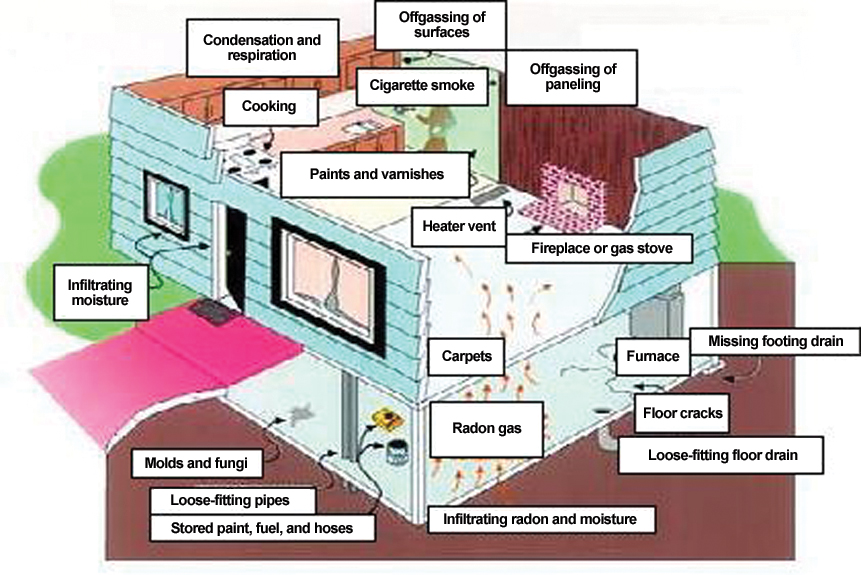
The pictorial  from the CDC below illustrates some common concerns with building a tight home. Proper ventilation is essential to prevent compounding of these issues which can result from tight building practices. . Reducing the amount of infiltration / exfiltration is also healthier for the building.

 
You cannot rely on a leaky, non ventilated house to ventilate itself via infiltration/exfiltration, exhaust fans (bathroom, range hood). Bringing in fresh air is just as important as exhausting stale air. Opening windows is a great ventilation solution, but these sources for poor indoor air quality (above) still exist in the winter (and summer when you are air conditioning) when you have the windows closed.

The bath fans and range hoods in a standard house provide spot ventilation by mechanically exhausting air. The fresh air is then drawn into the house through a different 'path of least resistance'. A passive house, however, is equipped with an air tight structure and a whole house ventilation system.

In a passive house, usually the best indicator of indoor air quality is carbon dioxide concentration.  In our area outdoor carbon dioxide levels are in the 400-500 parts per million (ppm). The whole house ventilation system is designed to keep the indoor air at outdoor levels. Some of the most common sources of carbon dioxide in a home are:

  • Respiration (A typical human breath contains about 100 times the outdoor levels)
  • Cooking with gas (by product of combustion - along with water vapor)
  • Unvented Gas Furnaces (THESE ARE NEVER A GOOD IDEA!)
This is a graph from a 2012 publish paper that was assessing CO2 levels and inhabitants decision making


As you can see, in an office setting it only take 50 minutes before CO2 levels can rise to a level leading to poor performance.

To keep CO2 levels reduced in a passive house we always focus on the sources first. So it is easiest to no have any combustion appliances in a passive house (That includes, fire places, gas stove, gas dryers, furnaces, gas water heaters, etc) - it doesn't mean you can't have them, it just means it is much better if you don't. Then all we are worried about is the CO2 from respiration.

Ventilation System Design
This is where the design of the ventilation system comes in.

We want to supply fresh air to bedrooms and living spaces.
We want to remove odorous and stale air from bathrooms and kitchens (and laundry too).

We keep the supply and extract registers within the house separated to allow proper penetration of fresh air throughout the home. If the fresh air is being supplied into the bedroom, the extract register in the bathroom will draw that fresh air through the house toward bathroom where it will be extracted. If the registers are too close together the fresh air will not be as efficiently distributed.


See our proposed ventilation system design from Zehnder America

The blue dots indicate supply air. The red dots indicate the extract air. We will be supplying air to all of the bedrooms, and the office and we will be extracting air from all of the bathrooms, laundry room and the kitchen (the placement of the extract in the kitchen is intentional, this will allow efficient extraction of the cooking smells while limiting grease buildup on the register by avoiding close proximity to the range). We will run a charcoal recirculating hood above the range to remove the cooking grease.

The Zehnder America System will be supplying about 120 CFM continuously of fresh filtered air. In contrast the standard furnace fan runs at about 1200 CFM, and is just recirculating the air already inside your house, not supplying fresh outdoor air. The air flow for the Zehnder System is so low, you will not feel the air moving through the registers.

See this video for more details on the Zehnder Comfosystem


I should mention that the earth tube idea mentioned in the video is not really a good idea in our area due to the much wider temperature range and higher humidity levels than in Central Europe (where Zehnder system was designed for). There is another option that we will be using from Zehnder. It is called Comfofond. It is actually a small geothermal loop installed around the footer of the house. The loop is filled with brine and flows though a heat exchanger to temper the incoming air in the summer and winter. For example, in the winter the 5 degree outdoor air will be raised to about 40 degrees using the heat in the ground which is delivered by this brine loop, this will make the ventilation heat recovery more efficient.

I should clarify that this geothermal system is not a heat pump like those systems you commonly see advertised or installed in our area, it does not require wells or loop field or any extra excavation to install. No refrigerant is needed. It is not designed to heat or cool the house, it is only designed to temper the incoming air to make the ventilation system more efficient. There is also a significant cost difference when using the Comfofond system as compared to a full geothermal heat pump system for whole house heating. Geothermal heat pump systems also do not provide ventilation as the Zehnder system does.

So this diagram shows how the heat exchanger works
The Comfofond system is installed directly in front of the 'fresh air in' to ensure maximum efficiency.

The Zehnder system is up to 90% efficient and when combined with the Comfofond you can be extracting 68 degree air from the home and supplying fresh outdoor air at 66 degrees when it is only 5 degrees outside!

So now a single air source heat pump inside the house will only have to heat the incoming air 2 degrees to maintain the temperature in the home. In a standard house, with leaky walls, your furnace is trying to heat the incoming 5 degree air back up to a comfortable temperature and meanwhile your heated air continues to escape through the walls-incredibly inefficient!

In the next post we will talk more about how the air source heat pumps improve efficiency over a standard build.